
The Difference Between Cast Steel Balls And Forged Steel Balls
Aug 13, 2021
In our popular sense, steel balls can be divided into three categories: cast steel balls, forged steel balls, and ductile cast ball grinding balls. But nowadays, nodular cast iron grinding balls are used very rarely, and casting balls and forging are more commonly used. However, in China, 90% of manufacturers use cast grinding balls as grinding media, while forged balls are used in foreign countries. Let's take a look at the characteristics of cast balls and forged balls:
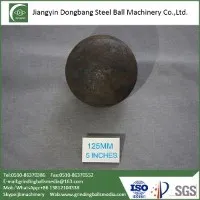
The steel balls produced by casting and smelting are called cast steel balls; the steel balls that do not require smelting and casting, but are just produced by forging are called forged steel balls. Although there is only one word difference between the two, the difference is huge.
The forged steel ball is directly heated at high temperature and then forged and formed by air hammer and other equipment. After simple heat treatment, its chromium content is 0.1% to 0.5%, and its carbon content is less than 1.0%. After high temperature forging, the surface hardness (HRC) can reach ≥56, but due to poor hardenability of the material, the hardenable layer is only about 15mm, so the core hardness is generally only more than 30 degrees, and the larger the diameter of the steel ball, the worse the hardenability. Therefore, under normal circumstances, forged steel balls are treated with water quenching.
In terms of wear resistance, the hardened and tempered high chromium balls (HRC≥60) have higher hardness, which is more than 2.5 times higher than the wear resistance of forged steel balls. By comparison, we can see the obvious advantages of cast balls over forged balls. According to scientific experiments, the ball consumption per ton of raw ore for forged balls is more than twice that of cast balls.