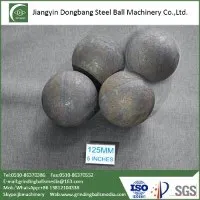

The Grinding Media Balls affects the grinding production capacity and the level of steel consumption and energy consumption
Aug 22, 2022
For fixed ball loading, the larger the ball diameter is, the smaller the number of balls. The number of blows to the ore particles during each grinding cycle is less, the total grinding area of the ball charge is also reduced, and the chance of the ore particles being hit and grinding is reduced. , the yield of the grades that are not finely ground in the grinding product will inevitably increase, and the production capacity of the mill will decrease. At the same time, if the ball diameter is large, the crushing force will increase accordingly. There are many over-grinding grades in the product, and the grinding effect will deteriorate; Small, although the number of blows to the ore particles increases in each cycle, due to the small energy of the steel ball and the insufficient striking force, the ore particles cannot be effectively broken, and the level of non-fine grinding will also increase. However, the large increase in the grinding area caused by the small ball diameter will inevitably lead to an increase in the level of over-grinding and a deterioration of the grinding effect.
The results of the dressing plant test show that when the ball diameter of the mill is close to the required ball diameter for grinding, it has little effect on the grinding, but once the size of the grinding medium deviates from a certain range, the grinding effect will deteriorate sharply. Therefore, if the ball diameter is too large or too small, it will lead to the increase of coarse and fine grades in the grinding product, uneven product particle size, and low production capacity of the mill, which is unfavorable for the sorting operation. Therefore, only when the size of the steel balls is appropriate, the ore particles can be effectively broken and a good grinding effect can be achieved.
The steel ball size is too large or too small, in addition to the unfavorable effect of grinding technology, there are other disadvantages. The size of the steel ball is too large and the crushing force is large, which is easy to cause the abnormal loss of the steel ball to rise. Production practice also proves that the energy consumption in grinding is often proportional to the steel consumption, and the energy consumption is also high when the steel consumption is high, generally 0.035-0.175 kg/kW·h, and the unit energy consumption of large diameter steel balls is high The unit energy consumption of steel balls with small diameters.