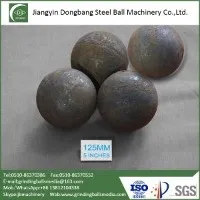

Steps and methods for producing Steel Balls For Mining
Aug 01, 2021
Production process: After passing the inspection, the round steel bar is cut according to the size of the steel ball; the steel forging is heated to a certain temperature by the intermediate frequency furnace to ensure that the deformation can occur during the forging; the red hot steel forging is sent to the air hammer In, it is processed by skilled operators. After forging, the red hot steel ball immediately enters the specially designed heat treatment equipment of Yilaite Co., Ltd. for quenching-tempering heat treatment, so that the produced steel balls can obtain high and uniform hardness values.
Features:
1. The crushing rate is less than 0.5%
2. High impact toughness: The impact toughness is greater than 18J/cm2, and the 8-meter ball drop test is more than 20,000 times.
3. High overall hardness: the surface hardness is 58-65HRC, the volume hardness is 56-63HRC, and the hardness gradient is evenly distributed.
4. No deformation: The steel ball never deforms or loses its roundness. 5. Dense organization, high cost performance, and obvious cost savings.
Development trend: With the continuous research and development of raw materials and the continuous upgrading of production equipment in recent years, the application fields have become more and more extensive, especially in semi-automatic mills such as metallurgical mines and ball mills with a diameter of more than 2.5m. Forged steel balls have low wear. The breakage is low, and the advantage is more obvious than that of cast steel balls. In terms of the current wear-resistant steel ball market, forged steel balls are commonly used in wet grinding applications in foreign metal mines and other wet grinding applications. In the domestic market, cast steel balls are currently used more, but the forged steel ball market is increasing year by year.