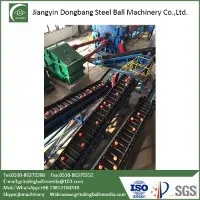

The Production Process Of Wear-resistant Grinding Steel Balls
Apr 28, 2022
Wear-resistant Grinding Steel Balls are an important part of future wear-resistant materials, and the production process of wear-resistant steel balls is the key to future competition in the field of wear-resistant materials technology. First, wear-resistant steel balls are produced by forging.
The first step is heating, heating it with fuel (coal or natural gas) to a specific temperature, then forging with an air hammer, then heat treating, and finally forming. Disadvantages: large labor demand, high temperature radiation to employees, serious noise pollution, low production efficiency, product quality cannot be guaranteed, product quality and production process standards fluctuate greatly.
Second, after the production level of obliquely-rolled wear-resistant steel balls has been improved, the oblique-rolled process has gradually replaced the traditional process. The basic principle is to heat the steel into a liquid with an electric furnace, flow into the ball groove through the device, and finally form it obliquely.
Third, automatic production of wear-resistant steel balls.
At present, some powerful steel ball manufacturers, such as Kaiyuan Wear-resistant, have begun to use fully automated production lines. The company's large balls with a diameter of more than 40mm use iron mold sand-coated ball production lines, and small balls with a diameter of less than 40mm use fully automatic production lines. Sand production line, the company has constant temperature pouring machine, intermediate frequency electric furnace, tempering furnace, and automatic oil quenching production line, which can be said to be fully automated in terms of production, pouring, and heat treatment.