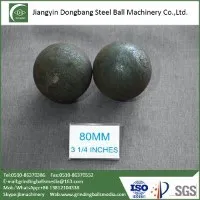
The relationship between temperature and Grinding Media Balls
Oct 21, 2021
1. The main control point of forging and rolling steel balls is the temperature of the steel balls
In the production process of steel balls, temperature is always the most important quality control point. Whether in forging heating, isothermal waiting, heat treatment, tempering and warehousing after tempering, temperature control plays a very important role, and even affects the metallographic structure of steel balls. 2. Analysis under heating conditions 1. Problems caused by excessively high temperature: oxidation-over-firing, which causes the internal structure of the steel ball to be coarse, and the hardness performance is unstable, asymmetrical, and uneven, and there is also a physical toughness impact value If it is too low, it can only reach about 3J/cm2. Taking the heating of round steel as an example, the following explanations are made: the oxidation rate of round steel is slow before 550°-600° after heating, and the oxidation speed rises rapidly only when it reaches 700° or above; assuming that the oxidation speed before 900° is 1, 1000° is 2 , 1100 degrees is 3, 1300 degrees is 7 (as shown below) The best temperature for forging: 980 degrees -1080 degrees; the best temperature for rolling: 950 degrees -1050 degrees; oxide scale-iron tetroxide, trioxide Three railways and so on. Note: No. 45 steel is carbon structural steel, and above B2 is composite steel (alloy structural steel). ⑴. Oxide scale is not only produced in the heating process, but also in the forging process; ⑵. The longer the heating time, the more oxide scale; ⑶. Solution: rapid heating and reduce heating time. 2. The problem caused by too low temperature: In layman's terms, the quenching is impermeable. Regardless of the surface hardness or the core hardness, the HRC cannot reach the required range value, which causes the steel ball to be non-wearing after the actual operation in the ball mill (partial Grinding), even broken. 3. The influence of the heating furnace: the heat energy conversion is different, the medium frequency induction heating speed is fast, but the burning is not thorough, commonly known as "hard fire". For example, the heating of composite steel seems to be at 1000 degrees, but in actual forging, there will be quite a lot of flexibility, which is not conducive to forging; and the same material appears easy after heating in coal stoves, natural gas stoves, and oil stoves. This is commonly known as "soft fire". The heating process of "soft fire" involves slow processes such as preheating and high temperature. Third, the relationship between the temperature of the mill and the ball 1. The operation of the mill is divided into dry grinding and wet grinding, which is also a significant feature that distinguishes cast steel balls from forged steel balls. 2. When the mill is running, overhauling or replacing the liner, it is necessary to pour out all the steel balls in the mill. This requires attention to the changes in the temperature of the steel balls when back grinding, especially the composite steel balls. If the temperature of the steel ball after operation is significantly reduced (or a large amount of water injection method is used), the surface peeling, peeling, or even directly broken phenomenon will occur.
https://www.grindingballsmedia.com/