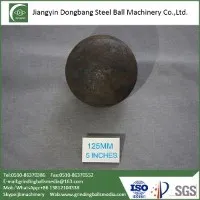

Comparison characteristics of hot-rolled ball mill steel ball and cast ball
Aug 19, 2021
In recent years, the domestic market is gradually introducing a new type of ball mill steel ball-hot-rolled ball mill steel ball, which can be widely used in mining and concentrators, thermal power plants, cement plants, refractory plants and other industries that require grinding machines. Hot-rolled ball mill steel balls are of good quality, cost-effective, and energy-saving and environmentally friendly production process. At present, they have been widely used by large foreign mining companies and have gradually replaced traditional casting balls. Research on Hot Rolled Ball Mill Steel Ball
The difference between hot rolled ball and cast ball
In recent years, the domestic market is gradually introducing a new type of ball mill steel ball-hot-rolled ball mill steel ball, which can be widely used in mining and concentrators, thermal power plants, cement plants, refractory plants and other industries that require grinding machines. Hot-rolled ball mill steel balls are of good quality, cost-effective, and energy-saving and environmentally friendly production process. At present, they have been widely used by large foreign mining companies and have gradually replaced traditional casting balls. The research on hot-rolled ball-milled steel balls will help environmental protection and energy saving, improve the technological level, and at the same time improve the economic benefits of the enterprise.
The materials used in hot-rolled balls and cast balls are different:
Hot-rolled steel balls-the raw material is low-alloy high-carbon special steel, and the finished round steel produced by a regular special steel plant is used. At the same time, the special steel plant is required to use hot-rolled and extruded square billets of more than 16 times the volume;
Cast steel balls-the raw materials are mainly collected scrap steel materials, and a certain proportion of alloy elements are added and cast.
The difference of the above raw materials determines the different properties of hot-rolled balls and cast balls in the following four aspects:
1.2. The principle of forming the hardness of the steel ball is different.
The hot-rolled ball rapidly cools the hot steel ball through a unique quenching process, prompting the austenite in the metal microstructure to quickly turn into a martensite structure with considerable wear-resistant hardness, so it is the hardness produced by quenching. Its hardness can reach 63~65HRC.
Casting balls mainly rely on adding a certain amount of alloying element chromium (Cr) to make steel balls have a certain hardness and wear resistance. The higher the Cr content, the better the hardness and wear resistance of the balls, but the cost of the steel balls The higher the Cr content of domestic high chromium balls is generally 8~12%, the hardness is 55~59HRC; the latest high-alloy cast ball contains Cr up to 18%, and a small amount of tungsten (W) is added. Rare metals such as molybdenum (Mo) have a hardness of 60-62HRC and good wear resistance, but the production cost is higher, and the sales price per ton is more than 14,000 yuan.
1.3. The density is different.
Because the hot-rolled ball uses round steel produced by hot-rolled and extruded square billet as the production raw material, and the hot-rolled ball is produced through roll forming and extrusion, the density of the hot-rolled ball is generally greater than 7.85g/ cm3 or more.
Because the casting ball adopts the traditional molding sand casting process, the inside and surface of the steel ball will inevitably produce pores and sand inclusions, and there are also casting waste edges, so the density is generally below 7.75g/cm3.
1.4. The uniformity of quality is different.
Because the hot-rolled ball is made of finished round steel, the quality is uniform, and the round steel enters the natural gas heating furnace → rolling mill → quenching machine → tempering furnace → cooling ball table → packaging, the entire production process has realized the large-scale production operation mode of the automated assembly line. The process parameters such as speed and speed are controlled by computer, which helps to ensure the stable and uniform production quality.
The scrap steel used in the casting ball itself has uneven materials. At the same time, the batching ratio and casting speed of each furnace are greatly affected by human factors, and the continuity of the production process is difficult to ensure, so the product quality is difficult to stabilize.
1.5. Impact toughness and crush resistance are different.
Due to the high density of hot-rolled balls, impact toughness ≥7J/C㎡ (large balls with a diameter of 100mm or more ≥18J/C㎡), 6m high drop ball test fatigue life ≥10000 times (industry standard is 3.5m high drop ball test fatigue life ≥8000 times ), so the broken rate is very low.
Due to manufacturing defects such as pores and sand inclusions, casting balls generally have an impact toughness ≤ 4 (J/C㎡), and have poor resistance to crushing. The falling ball test cannot be performed, so the crushing rate will be higher.
Recently, with the large-scale mill diameter, the requirements for the impact toughness and crush resistance of the grinding steel balls have become higher and higher, especially for the cast balls of mill equipment with a diameter of more than 8 meters, which can no longer meet the requirements of their working conditions.
In summary, hot-rolled balls and cast balls are two kinds of balls with different concepts. The former is not only superior in performance, but also high in labor productivity, environmentally friendly and energy-saving in the production process. It can implement a large-scale production operation mode of automated assembly line, while the consumption of cast ball alloy resources is large. , A lot of pollution, high energy consumption, low production efficiency. The replacement of cast balls by hot-rolled balls is inevitable for the steel ball manufacturing industry to achieve energy saving, emission reduction and industrial upgrading. At the same time, the use of hot-rolled steel balls is also an effective measure for related enterprises to reduce costs and save capital.